@buyforme.amazon, Who Dis?
Or...The Agent Identity Crisis

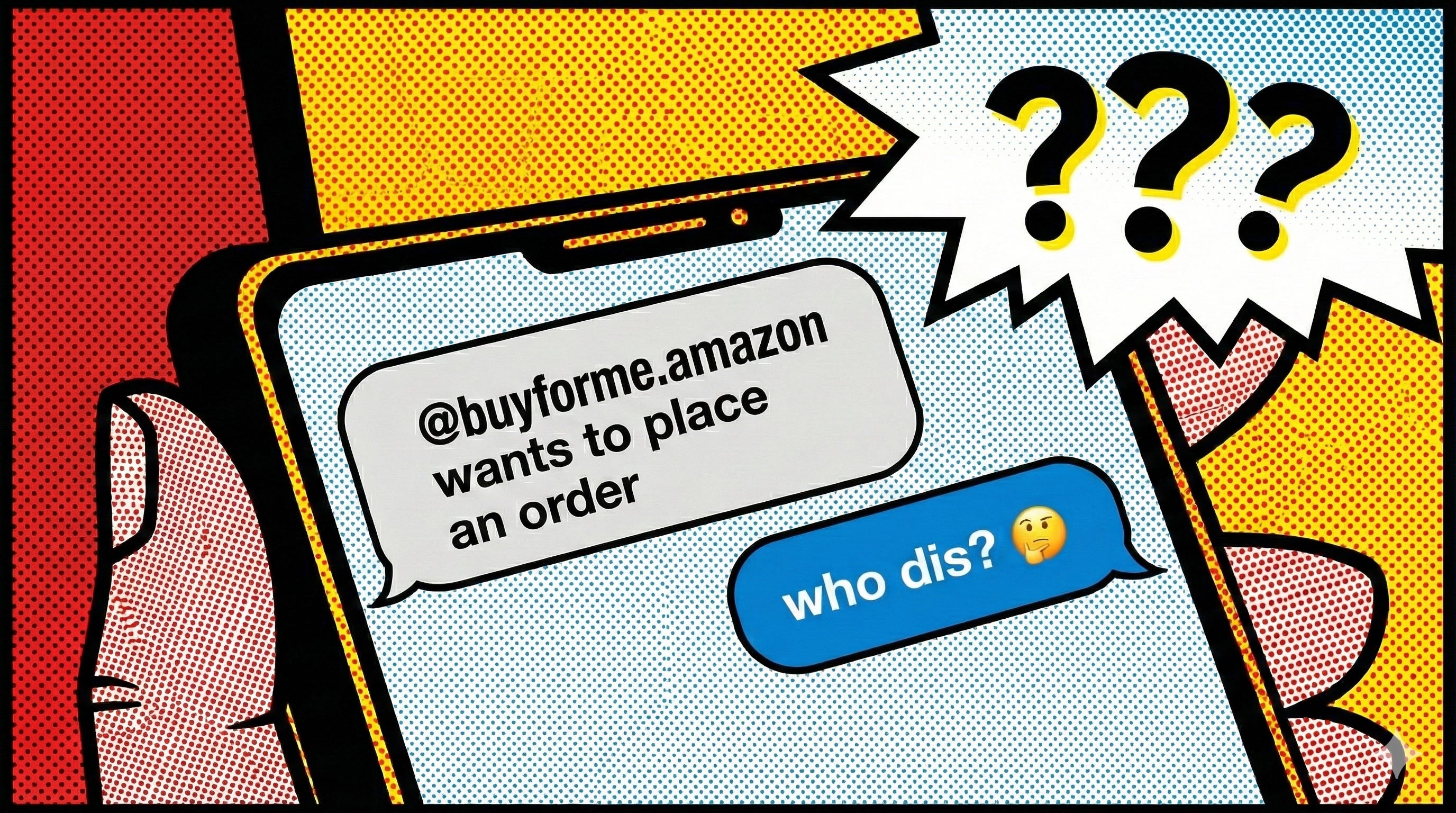
Battle lines are being drawn in agentic commerce. But the platforms racing to deploy shopping agents forgot to build the trust infrastructure that would make them accountable.
When retailers started getting orders from @buyforme.amazon, they had a simple and very reasonable question: Who are you?
Not philosophically. Practically. Are you authorised by Amazon? What are you allowed to buy? Who’s liable when you order products that don’t exist (which it totally did)? How do we verify any of this?
They couldn’t answer. Because the agent credentialing infrastructure doesn’t exist.
Amazon blocked agents from their ecosystem and then send their agent out…unidentified, into the wider e-commerce landscape to shop. The freaking AUDACITY of this burns.
Don Scheibenreif saw the bigger picture forming. When Amazon sued Perplexity for “computer fraud” while simultaneously launching its Buy for Me agent, the Gartner Distinguished VP who coined “machine customer” commented on my post: “Battle lines are definitely being drawn... It makes me wonder what coalitions will form and who will stay open.”
Everyone’s watching the strategic battle. Which platforms build walls? Which stay interoperable? Who wins the intermediary broker position?
But there’s actually a more fundamental problem. These agents yet can’t prove who they are.
The Orders That Prove the Problem
Hitchcock Paper, a Virginia stationery supplier, started getting orders for stress balls in December 2025. Dozens of them. All from an email address ending in @buyforme.amazon.
This is problematic. Hitchcock Paper doesn’t sell stress balls. Has never sold stress balls. Doesn’t stock stress balls. WTF?
Bobo Design Studio got orders for a vinyl sticker. Amazon’s agent displayed a photo of pants. “It was a totally random stock image,” CEO Angie Chua told Modern Retail. “I don’t sell pants.”
Mochi Kids discovered 4,000 of their products listed on Amazon through Buy for Me. One of their wholesale partners, whose contract explicitly prohibits Amazon sales, called to ask why they were breaking their agreement. They weren’t. Amazon’s agent was.
More than 180 businesses contacted Chua after she posted about it. All reporting the same thing that the received orders from @buyforme.amazon for products they don’t carry, products they discontinued months ago, products that violated their distribution contracts.
When retailers tried to verify these agents’ authority, they couldn’t. No credentials. No capability boundaries. No performance history. Just anonymous orders from an email address claiming to represent Amazon.
So the bigger problem here is how do you verify an agent is legitimate when the agent credentialing infrastructure doesn’t exist?
The Race Nobody’s Watching
While everyone’s focused on Amazon suing Perplexity and Google launching Universal Commerce Protocol, the real story is what’s not being built.
Amazon: Blocked 47 AI agents, sued Perplexity for “computer fraud,” then launched Buy for Me, deploying an unverified agent across 500,000+ products.
Google: Built UCP to standardise agent transactions across Walmart, Target, Shopify, Etsy and many others, enabling agents to bypass merchant checkout flows entirely.
OpenAI: Announced ads coming to ChatGPT on January 16, 2026. Internal documents from December show staff discussing giving “sponsored chatbot results preferential treatment” but publicly they’ve stated they won’t. They’re adding revenue conflicts before adding credentialing systems.
The pattern thats emerging here is every platform is racing to capture the intermediary broker position. None of them are building the trust infrastructure that would make agents accountable.
In my book, I wrote about the Agent Name Service (ANS), a credentialing framework inspired by DNS from OWASP that would give agents “professional licensing.” It would provide:
Agent credentials: Proof the agent is authorised to act
Capability verification: Clear boundaries of what it can do
Performance history: Track record of successful transactions
Provider accountability: Who backs this agent and takes liability
The credentialing infrastructure doesn't exist though. And by the time it does, the platforms will have already captured the market. That's not an accident. That's the strategy.
Visa even posted about the coming crisis when merchant systems can't distinguish legitimate machine customers from nefarious fraud bots through identity scams in their 6 trends in payments for 2026. This is real and this is now.
OpenAI’s Ads Somewhat Two Faced Announcement
On January 16, OpenAI announced ads coming to ChatGPT. The public statement: “Ads do not influence the answers ChatGPT gives you.”
Internal documents from December tell a different story. Staff were discussing how to give sponsored products “preferential treatment” in recommendations. One example could be a user asks about ibuprofen dosage, gets an Advil ad that might push actual dosage information aside.
This is the structural conflict my earlier article on Amazon mapped. Every intermediary broker serves multiple masters: user experience, advertiser revenue, platform control. These goals are incompatible.
The credentialing gap is lethal. Without agent verification infrastructure, retailers can’t detect when recommendations are biased.
Sure, the credentialing gap enables mistakes but it also enables manipulation at scale.
All Go! No Slow! Why Platforms Won’t Build This
The platforms need position captured right now.
McKinsey projects $1 trillion in agentic commerce by 2030. Morgan Stanley expects nearly 50% of shoppers using AI agents. The intermediary broker position is being claimed right now. Network effects will lock it in.
But credentialing systems require:
Industry standards (years of negotiation)
Regulatory frameworks (government moves slowly)
Verification infrastructure (expensive, complex)
Liability frameworks (lawyers, insurance, accountability)
That takes 5-10 years. The platforms are racing to capture market position in 2-3 years.
So they’re deploying unverified agents at scale and dealing with consequences later.
Amazon launched Buy for Me without agent credentials. Retailers are discovering phantom products, contract violations, and inventory chaos. Amazon’s response: “Email us to opt out.”
Google built UCP without verification standards. The protocol standardises transactions but not agent identity. Who’s verifying these agents are authorised? Who’s checking capability boundaries?
OpenAI’s adding ads to ChatGPT while claiming neutrality. Where’s the disclosure framework? Where’s the audit trail showing which recommendations were influenced?
They’re all building the transaction layer before building the trust layer.
What to Demand Monday Morning
Don’t just audit platform conflicts. Demand agent credentialing as a prerequisite for integration.
Before you integrate with ANY shopping agent platform, require answers:
Agent Identity:
How do we verify this agent is authorised by your organisation?
What cryptographic or blockchain-based credentials does it present?
Where’s the public registry we can check?
Capability Boundaries:
What is this agent authorised to do?
What are the explicit limits on its authority?
How do we verify it’s operating within boundaries?
Performance History:
What’s this agent’s transaction success rate?
How many errors has it made?
What’s the error correction process?
Provider Accountability:
Who takes liability when this agent screws up?
What’s the insurance backing these transactions?
Where’s the dispute resolution framework?
Conflict Disclosure:
How do we know if a recommendation was influenced by revenue?
Where’s the audit trail showing sponsored vs organic recommendations?
What’s the disclosure mechanism?
If they can’t answer these questions, don’t integrate.
The Standard That Should Exist
In a recent interview, I said: “How do we onboard that agent into our systems like we would a person who wanted to buy something from us?”
The answer should be: the same way we verify humans.
Humans need:
Government-issued ID (verification of identity)
Credit history (track record)
Physical address (accountability anchor)
Authorisation (power of attorney if acting for someone else)
Agents need:
Cryptographic credentials (verified by blockchain or similar)
Performance history (immutable transaction record)
Provider backing (clear liability chain)
Authorisation scope (capability boundaries in the credential)
This isn’t theoretical. The infrastructure exists. ERC-8004 is a blockchain standard for agent credentials. Visa and Mastercard are building agent payment verification. Companies like Trulioo are developing KYA (Know Your Agent) frameworks. The light in this dark hole of shady operating is that KYA is being pushed forward by global payments powerhouse, Worldpay, to create this trust layer.
The technology exists. The standards are emerging. But it’s not fast enough.
I don’t know if the platforms will adopt it because credentialing adds friction. They’re optimising for transaction volume, not transaction trustworthiness.
This Matters Beyond Shopping
The agent credentialing crisis in shopping is a preview of what’s coming everywhere.
AI agents are making decisions in:
Healthcare (diagnostic recommendations, treatment plans)
Legal services (contract analysis, compliance checking)
Financial planning (investment allocation, tax strategies)
Supply chain (procurement, logistics, vendor selection)
Every one of these domains will face the same question: How do we verify this agent is authorised, capable, and accountable?
Shopping is where it’s breaking first because:
The stakes are lower (wrong product vs wrong medical treatment)
The volume is higher (testing at scale)
The regulation is lighter (easier to deploy without oversight)
But the pattern will repeat. Platforms will race to deploy agents before building credentialing infrastructure. By the time regulators catch up, the facts on the ground will be established.
Shopping agents are the canary in the coal mine.
The Choice We Face
You can wait for platforms to build credentialing infrastructure. They won’t. They’re racing to capture position, not build accountability.
You can wait for regulators to mandate agent verification. They will. In 5-10 years. After potentially millions in fraud.
Or you can demand it now.
Make agent credentialing a requirement in your RFPs. Refuse integration with platforms that can’t verify agent identity. Build industry coalitions demanding verification standards.
The platforms won’t fix this. They benefit from the credentialing gap.
But you don’t have to accept it.
Demand agent credentials. Make verification a prerequisite. Build the industry coalition that forces platforms to implement credentialing infrastructure.
Or watch as unverified agents making biased recommendations become the new normal in commerce.
The choice is yours. But decide quickly.
Because @buyforme.amazon is already placing orders.
Katja Forbes is the author of “Machine Customers: The Evolution Has Begun” and helps organisations design customer experiences for AI agents, autonomous systems, and algorithmic buyers. Connect with her at thecxevolutionist.ai