Physical AI Has a Wallet
Or Everything That’s Autonomous Has The Ability To Transact.

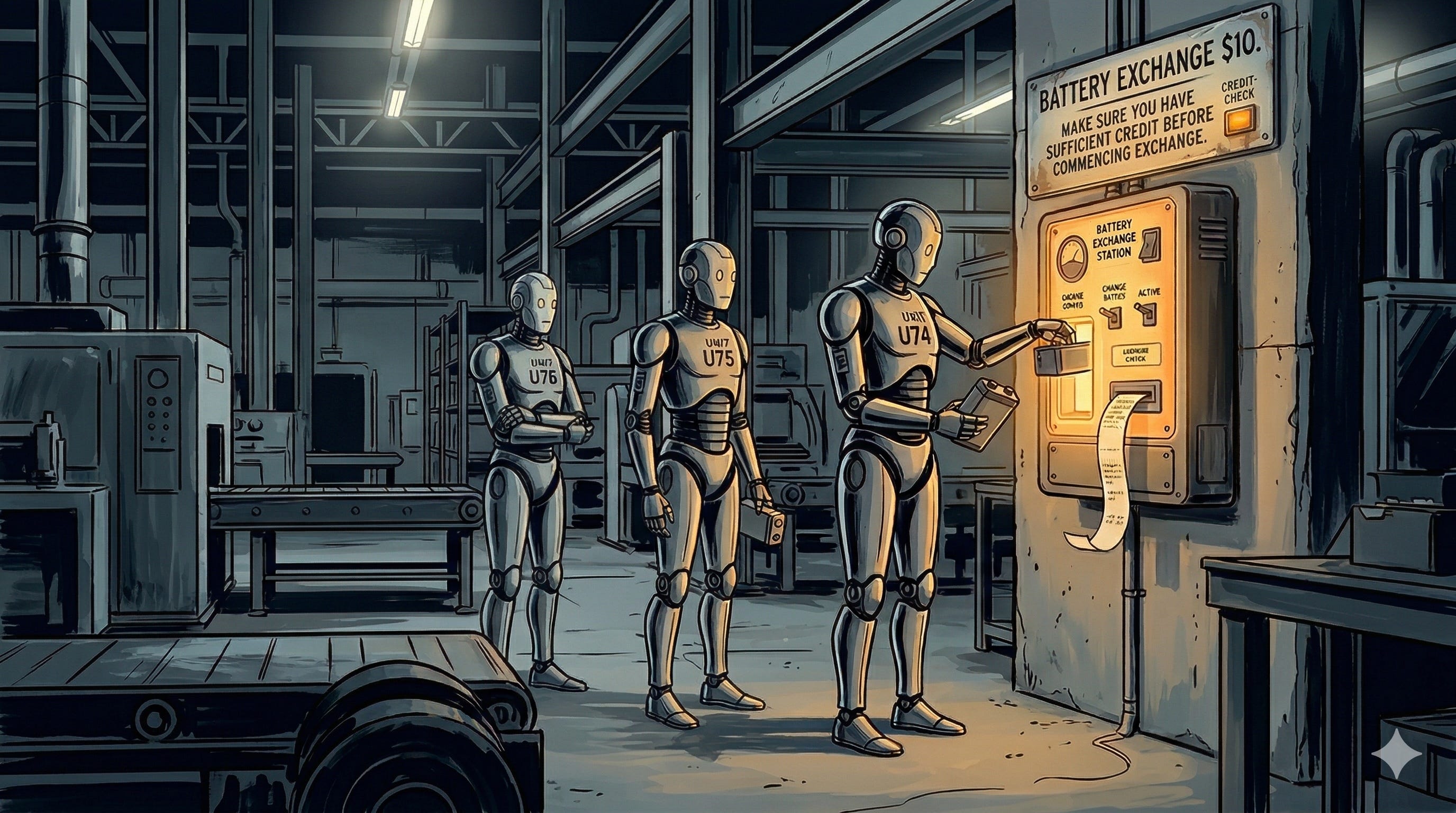
Jensen Huang said “everything that moves should be autonomous.” He’s right. But he stopped one sentence too soon.
Everything that’s autonomous has the ability to transact.
Two weeks ago I was presenting online to more that 300 people working in automotive manufacturing, including engineers, strategists, executives from across the world, when I put up a slide with two sentences on it.
The cars you build become machine customers in the world. Machine customers are also already arriving at your door.
I watched the chat and reactions light up.
These are people who have spent careers thinking about the car as something you design, manufacture, and hand to a human. The human is the customer. The car is the thing you sell.
That model has a shelf life and in that session, with those two sentences on screen, you could see the moment both sides of it landed simultaneously. The people building autonomous machines hadn’t fully reckoned with the fact that they were building buyers. On the flip side, the businesses those machines would buy from had no idea the customer was changing shape.
The car isn’t a product anymore. It’s a buyer and most organisations haven’t designed for that…on either side of the transaction.
Jensen Huang has a term for what’s driving this. He calls it Physical AI.
At CES in January 2026, he declared “the ChatGPT moment for physical AI is here — when machines begin to understand, reason and act in the real world.” NVIDIA’s physical AI business already contributes over $6 billion to annual revenue. His vision: every car, every truck, every robot, eventually autonomous. A billion autonomous cars on the road.
There is also another term for this. They are called Machine Customers, non-human economic actors that transact, obtaining goods and services in exchange for payment. I wrote a book about them.
Jensen’s statements at CES are really profound, but there’s a connection to be made here that I don’t think people are quite getting yet. Physical AI and Machine Customers are the same threshold arriving from two different directions. Jensen’s term describes the capability when machines that sense, reason, act. Mine describes the commercial consequence about machines that buy. One is a chip story. The other is a revenue story.
They converge at the exact moment the machine doesn’t just act. It transacts.
Arm, the chip architecture company whose compute platform powers most of the physical AI you’ll read about, framed it this way earlier this year:
“Smartphones became true platforms when computing power, connectivity, and developer ecosystems aligned… A similar alignment is now happening across vehicles, robotics, and other autonomous machines.”
The smartphone didn’t stay a phone. Within three years of launch it was a commerce platform. That parallel matters, and I’ll come back to it.
First, I expect you want to explore a few proof points. You might be surprised that this isn’t a future scenario. There are functioning and profitable examples of this in the market today.
HP’s Instant Ink has been around for years. A printer that orders its own toner cartridges before they run out. Most people know this one. That’s the point. It’s been hiding in plain sight for so long we forgot it was the proof of concept for an entirely new customer category. A machine, transacting autonomously, generating over half a billion dollars a year in recurring revenue for HP Supplies. We already live in a world of machine customers. We just stopped noticing.
Now scale that logic.
Boston Dynamics’ Atlas robot, in production and shipping in 2026, autonomously navigates to a charging station and swaps its own batteries when power runs low. Under three minutes. No human required. Not a concept. It’s in the spec sheet and when one Atlas learns a procurement behaviour, Boston Dynamics’ Orbit fleet management platform replicates it instantly across the entire fleet. The robot that procures its own energy today will order its own replacement parts tomorrow. How many people on the selling side has prepared for a customer that never sleeps and never calls?
The 2026 Mercedes-Benz CLA automatically reserves its own charging slot, pays for parking on entry and exit without the driver touching their phone, and purchases software upgrades over the air. Mercedes CEO Nico Kersten said it plainly a few years ago, and it’s only become more true:
“eCommerce started on the web, but now it’s shifting to the vehicle.”
I always think it’s fun to ground things in an example, so in the talk I gave the automotive teams I created a little role play. While the owner sleeps, the car can be booking its own service through Flexible Service System (ASSYST+).
Why did Stuttgart West miss out on the business? Because it was not machine readable and ill-prepared to transact with a machine customer.
There’s another quiet layer most people haven’t noticed. Fitch Ratings has flagged that as autonomous systems take over driving, liability migrates from the driver to the manufacturer. When a car company accepts liability for what its car does, the car company becomes the insurance buyer too. The machine customer relationship doesn’t just extend to charging and software. It extends to the entire risk profile of the vehicle.
At Caterpillar, 1.4 million connected machines are feeding data into an AI system that predicts hydraulic failures, identifies the exact replacement part from a catalogue of 1.5 million options, and initiates procurement via the Helios platform. The Cat AI Assistant, debuted at CES in January, puts that capability in-cab and it’s voice-activated, connected, always on. Unplanned downtime on a mining excavator costs over $1,000 an hour. That machine is not waiting for a human to notice a warning light. It can’t afford to…and increasingly, it won’t have to ask.
Off the coast of Norway, the Yara Birkeland has been in commercial operation since 2022 as the world’s first fully electric autonomous container ship, 250 voyages and 35,000 containers carried. On a fixed route, berthing fees are probably pre-negotiated and ERP systems handle the rest. But what happens when there’s an unscheduled decision like a weather reroute, an emergency port stop, where today a human captain makes a real-time procurement decision. Remove the captain. Nobody in port logistics has designed for what comes next.
In February, a company called Verkor published a paper documenting something pretty wild. Their AI agent, Design Conductor, autonomously built a complete, working CPU from a 219-word requirements document to production-ready chip layout in twelve hours. No human in the loop. The paper notes that bringing a new leading-edge chip design to market typically costs well over $400 million and takes 18 to 36 months, even with an engineering team numbering in the hundreds. Everyone covering this story wrote about speed and capability. Nobody asked the commercial question about when an AI agent designs a chip, that it is also sourcing components, commissioning manufacturing, and procuring tape-out services. Somewhere in that twelve-hour loop, a machine bought something from someone. Whose customer was it?
Is anyone your boardroom asking that question? If they’re not, they’re behind and dropping back further with each passing moment.
When a physical AI machine transacts autonomously, who controls the commercial relationship? The manufacturer who built the intelligence into it? The owner who deployed it? The AI platform embedded in its operating system?
Mercedes controls the charging relationship for its vehicles through MB.CHARGE, through its own charging infrastructure, through the Mercedes Me Store where software is purchased. Caterpillar controls the parts relationship through Helios, through its dealer network, through the AI that recommends and increasingly initiates the order. The businesses that bought those machines may find themselves progressively disintermediated from procurement their own assets conduct…on their behalf, using their budget, with diminishing human involvement.
And if you’re on the selling side? Well, machine customers don’t respond to advertising. They can’t be charmed by a sales relationship or swayed by a loyalty programme. They have no memory of how your customer service made them feel, because they don’t feel anything at all. They run on logic, continuously, and they will only choose you if your product data, pricing, and availability match their parameters at the exact moment they query you. If your data isn’t structured for machine readability, you’re not a low performer. You’re absent.
There’s no regulation for any of this yet. No jurisdiction has enacted rules specifically addressing liability when a machine customer makes a wrong purchase, negotiates a bad contract, or buys at the wrong price. The EU AI Act starts enforcement in August with fines up to 7% of global revenue, but it doesn’t answer whose fault it is when the machine gets it wrong. The commercial architecture is being built before the legal architecture exists. Landmark cases are coming within 24 months.
Back to that smartphone parallel.
Deloitte published data this week showing only 5% of firms say physical AI is transforming their organisation today. 41% expect it will within three years. The smartphone didn't become a commerce platform the day it launched. It became one while most businesses were still thinking of it as a communication device. By the time the commercial consequences were undeniable, the relationship had already been built elsewhere, on someone else's terms. That gap, between seeing it coming and designing for its commercial consequences, is exactly where the damage happens.
The companies that survive the physical AI transition will be those who designed for the machine as a buyer, not just a user. On both sides. The manufacturers who intentionally engineer the commercial behaviour of what they release into the world. And the suppliers who build for a customer that doesn't read brochures, whose data is structured, whose reliability is provable, and whose values match the criteria of the humans who decided what the machine is allowed to buy.
Every physical AI product your company builds or buys is a machine customer.
Have you designed it that way intentionally?
If not, the machine is already transacting. The commercial relationship is already being built. Just not necessarily by you, on your terms, in your favour.
Everything that’s autonomous has the ability to transact.
You need to ask who designed that transaction and whether the businesses on the other side of it were ready for a customer that never sleeps, never feels, and only buys on logic.
Most aren’t prepared. It’s time to check how ready you are.
I have two assessments you can use to check how prepared you are. One is the Agentic Commerce Readiness Assessment in collaboration with Geoff Gibbons from Human Machines. The other is my Values Signal Audit to see how well the values you purport to uphold are collaborated in the wider internet. Try them out and see how you fare.
Katja Forbes is the author of “Machine Customers: The Evolution Has Begun” and helps organisations prepare for a world where their next customer won’t have a face or feelings. She advises businesses and speaks globally on Machine Customer Experience and why customer focused leaders are uniquely positioned to shape this transformation.