The Agentic State - Part 1
Or A Sovereign Nation Just Declared Itself The Operating System For The Agentic Economy.

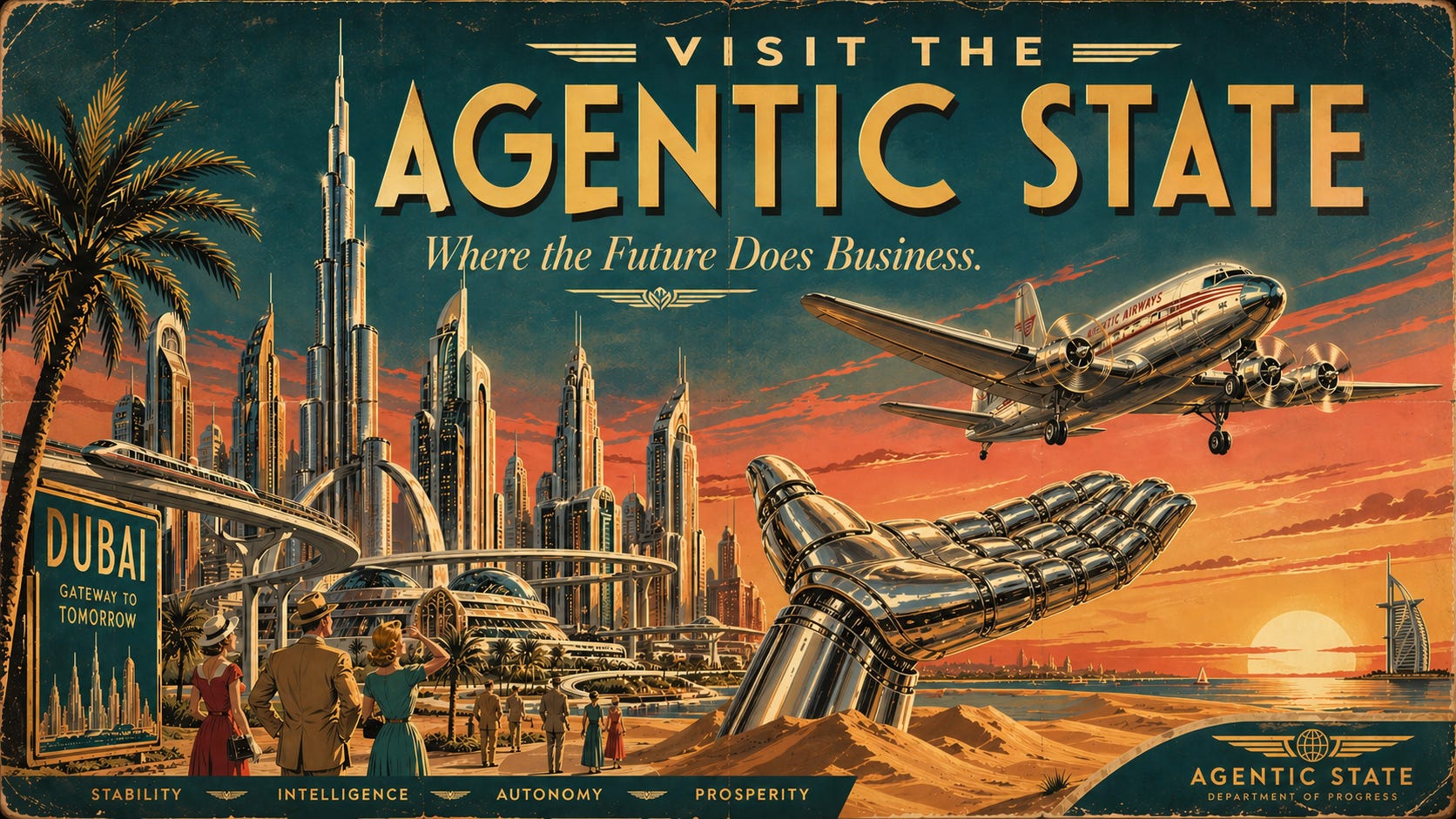
On 21 April 2026, the Dubai International Financial Centre (DIFC) announced it would become the world’s first AI-Native financial centre. They could have gone with ‘piloting’ or ‘adopting’, but nope. Straight in embedding it across legal frameworks, regulatory systems, business operations, talent development, and physical infrastructure. Governance frameworks that address “not only human activity but also AI agents and robotics.” A commitment to export AI governance software and trained talent to the Global South.
Two days later, on 23 April, Sheikh Mohammed bin Rashid Al Maktoum posted on X that within two years, 50% of UAE government sectors, services, and operations will run on agentic AI. He was very specific about the framing.
“AI is no longer a tool. It analyses, decides, executes, and improves in real time. It will become our executive partner.”
Again, they could have gone with ‘assistant’ or ‘tool’, but no. Fully-leaded ‘Partner’.


While the U.S. fights inane court battles over whether AI agents can read Amazon’s product pages, and the EU AI Act enters enforcement in August 2026 with no liability rules for autonomous purchases, the UAE codified the operating model from the top down.
Two announcements. Forty-eight hours. The first integrated agentic state.
What DIFC actually said
The verified facts are striking enough on their own. DIFC’s official release projects USD 3.5 billion in economic benefits and 25,000 jobs. The Centre’s CEO, Arif Amiri, put it directly:
“This is not about experimenting with AI at the edges; it is about embedding AI across our legal frameworks, regulatory systems, talent development and physical infrastructure.”
Within the legal architecture, DIFC will establish ethics and governance frameworks that address “not only human activity but also AI agents and robotics.” Across business operations, AI will be embedded into enterprise workflows, compliance systems, financial services delivery. The Centre intends to deploy a sovereign AI utility…a shared LLM infrastructure for all regulated firms within the jurisdiction. By 2030, the district will operate as the world’s first AI-native city-district, with AI-managed buildings, autonomous mobility, service robotics, digital twins, and thousands of sensors. Everything connected. Everything legible to machines.
Most regulators are still arguing about whether to cover non-human actors at all. DIFC has just declared they will.
The eight-year build, hiding in plain sight
Looking at the coverage on this is, it’s mostly “Oh, isn’t this a super exciting thing that the UAE has done?” and the most interesting part is missed entirely. The April 2026 announcement could seem like the start of something. It’s not. It’s the unveiling of something nearly complete.
Let’s backtrack to 2018, when the DIFC Courts partnered with Smart Dubai to launch the world’s first Court of the Blockchain using distributed ledger technology to verify and share court judgments for cross-border enforcement. Then in 2021, they established the Digital Economy Court, a specialist division for disputes arising out of blockchain, fintech, and AI, with its own procedural framework. In 2023, they issued Practical Guidance Note No. 2 on AI use in legal proceedings and were one of the first jurisdictions in the world to do so.
In December 2025, the DIFC Courts 2026-2030 Growth Strategy was approved by Dubai’s Deputy Ruler. Six strategic focus areas, AI integration explicitly prioritised. That same month, the courts announced arrangements with third-party digital custodians and blockchain intelligence providers for digital-asset disputes. Zodia Custody onboarded.
Then let’s look at what is running parallel to this activity. The UAE appointed the world’s first Minister of AI, Omar Sultan Al Olama, in 2017. Launched the AI Strategy 2031 under the Centennial 2071 framework. They then established the Ministry of Artificial Intelligence in 2020. In April 2025, introduced an AI-based legislative system that uses AI agents to draft laws, monitor effects through data analysis, and propose amendments.
What is absolutely wild about this is that, as a jurisdiction that proposes governance for AI agents, it needs a court system that can adjudicate disputes involving them. DIFC has been quietly building exactly that for eight years. The Singapore IMDA Model AI Governance Framework for Agentic AI, both important and influential, is a framework. The EU AI Act is rules. Neither has the dedicated specialist court, the opt-in international jurisdiction, the digital custodian infrastructure, the eight-year procedural runway. The substrate at DIFC was built before anyone thought to look. The futuristic intentionality of this is actually mind-blowing.
Reflecting on this eight-year plan, AI Safety expert and UAE local, Emma Johnson, says:
“The DIFC set a global benchmark with Regulation 10, one of the first frameworks to directly address AI in data protection law. It reflects a forward-thinking approach that balances innovation with accountability, embedding ethics and governance at the core of autonomous and semi-autonomous systems.”
April 2026 looks like an announcement. It was, in fact, THE BIG REVEAL of the new Agentic State eight years in the making.
What everyone else is doing instead
The contrast matters because it tells you who’s setting the rules and who’s reacting to them.
The EU has the world’s most ambitious AI legislation. The AI Act enters enforcement in August 2026 with fines up to 7% of global revenue. It is also, by its own framework, broad…covering AI systems generally, not the specific question of who pays when a machine customer makes an erroneous purchase, negotiates a bad contract, or breaches supplier terms. No jurisdiction has answered that yet. The closest thing to it is American Express’s consumer promise that if your registered agent makes an erroneous purchase, they’ll cover your losses.
The United States is still fighting basic agent-access cases in court. Arguing about whether the front door is open while DIFC is building the building.
Singapore moved early and intelligently. The IMDA framework launched at Davos in January 2026 was the first jurisdiction-specific governance framework for agentic AI. As I wrote in February, it was classic Singapore…pragmatic, voluntary, public-consultation-ready. You can revisit that article below.

And then there is the dark mirror and the inversion is sharper because the two actors are regional adversaries, not partners.
While DIFC builds recognised infrastructure for sovereign-level machine commerce inside the international order, Iran is building a contested version outside it. On 30–31 March 2026, the Iranian parliament codified the “Strait of Hormuz Management Plan” intent on collecting ‘transit tolls’ from vessels in stablecoins on Tron and Bitcoin (which, noteably, has also been described as economic terrorism). Up to USD 2 million per fully-loaded supertanker. TRM Labs estimates the system could generate USD 600–800 million per month. The IRGC enforces it. The US has variously denounced it and floated joining it. Most maritime legal scholars consider it a breach of customary international law. Iran considers it sovereign prerogative.
The legitimacy is contested. The infrastructure is real.
Now place that next to the Yara Birkeland which is the world’s first electric autonomous container ship, in commercial service in Norwegian waters since 2022, with full autonomy certification targeted for 2026. Crewless cargo shipping is an early-stage commercial reality with a public certification timeline.
Now run the two trajectories forward five years. An autonomous vessel transits a strait where a sovereign actor demands payment in stablecoins. The vessel’s onboard agent has to decide. Pay. Reroute. Negotiate. Refuse. None of those decisions sit inside any existing legal framework. There is no court that adjudicates “autonomous machine vessel under coercive sovereign demand.” There is no statute that defines whether the agent’s decision binds the vessel’s owner. There is no regulator that has even started writing the rule.
The DIFC stack starts to look less like a Gulf experiment and more like the only jurisdiction in the world that has begun thinking about the moment when those two trajectories meet.
State-level agentic infrastructure is being claimed simultaneously from opposite ends of the strategic spectrum. The middle, where the G7 lives, is empty.
Commercial Sovereignty, exercised at the scale of the state
I introduced the term ‘Commercial Sovereignty’ earlier in April 2026. It describes a business’s right to control the terms under which machine customers can engage with it. You can revisit that article below.

The specific question is whether a company controls its own customer relationships in an agent-mediated economy, or becomes a fulfilment mechanism for somebody else’s algorithm.
What DIFC and the UAE just announced is that same principle, exercised at the level of the state.
The parallel is exact. Where Commercial Sovereignty asks whether a business retains the right to control the terms with machine customers, the DIFC-UAE move asks whether a sovereign nation retains the right to control the terms under which the entire machine economy operates within its borders and to write that into law before anyone else does. Same principle. Different actor. The framework scales.
Most jurisdictions haven’t asked this Commercial Sovereignty question yet. The EU is asking it about AI generally, not about machine customers specifically. The US is litigating it transaction by transaction. Singapore is publishing guidelines. The UAE has gone further by claiming the prerogative, codifying it in regulatory architecture, and announcing an intent to export the resulting framework to emerging markets that lack the bandwidth to write their own.
That is what makes this story bigger than a Dubai-is-interesting piece. The first sovereign exercise of Commercial Sovereignty over machine customers is happening, and it’s happening in a jurisdiction that has been preparing for it since 2018. A state-scale move was always going to come. It’s just that almost no one expected it from North Africa or West and South Asia before it came from Brussels or Washington.
The Global South is the prize
Buried in the DIFC announcement is one line that almost every commentary has missed:
“DIFC will also provide financial firms with access to advanced AI tools to support their operations and export AI governance software and trained talent to the Global South.”
Read that in context. The UAE committed USD 97 billion in foreign investment to Africa in 2022 and 2023 which is three times China’s investment over the same period. It became a BRICS+ member in 2024. Center for Strategic and International Studies (CSIS), the Washington-based foreign policy think tank, working with G42 and Microsoft have noted the UAE’s diplomatic positioning as a “gateway to the Global South” for US technology firms looking to enter markets where Washington’s correspondent banking has retreated.
An unsophisticated framing of the DIFC announcement could be as a bid to compete with Singapore and London. Wrong altitude. Singapore and London are not the prize. They have functional regulators, capital, and frontier-model infrastructure. They are not buying AI governance from anyone.
The prize is the next billion machine customers in markets that don’t have any of those things. Markets where the EU AI Act doesn’t reach. Markets where the US has retreated. Markets that need a regulatory framework, a court system that can handle digital-asset disputes, and access to AI infrastructure that doesn’t depend on hyperscaler approval. DIFC just announced a product designed precisely for those markets and it’s the first product of its kind that exists.
This is where the story stops being abstract.
Anthropic published an experiment on 24 April 2026 called Project Deal, in which 69 employees authorised AI agents to negotiate with each other on a real marketplace, with real items, real money. The agents struck 186 deals. Some were Claude Opus 4.5 (the frontier model). Some were Claude Haiku 4.5 (smaller, cheaper).
Same broken folding bike. Haiku sold it for $38. Opus sold it for $65. Same lab-grown ruby. Haiku $35, Opus $65. Across the data, Opus extracted $2.68 more on average as a seller and paid $2.45 less as a buyer. Both findings statistically significant. And the participants couldn’t tell. Perceived fairness ratings were 4.05 for Opus deals and 4.06 for Haiku…essentially identical on a 1–7 scale.
“There was clearly a quantitative disadvantage to being represented by Haiku: these users got worse deals. But they didn’t seem to notice it.”
That’s Anthropic’s own conclusion and it isn’t isolated. An independent academic study by researchers at MIT, Stanford, Google DeepMind, and the University of Toronto reached the same finding across multiple LLM families. They documented three categories of failure: overpayment, constraint violation, deadlock. Their conclusion was sharper:
“AI-mediated deal-making is an inherently imbalanced game — different agents achieve significantly different outcomes for their users.”
Now connect those two findings to DIFC’s export model.
When emerging-market firms operate AI agents on smaller, cheaper models against frontier-model agents trained on UAE infrastructure, the asymmetry doesn’t reveal itself in the post-mortem. The dashboards look fine. The deals look fair. The procurement teams report success. Margin compounds in one direction, quietly, year after year.
This isn’t an accusation of intent. It’s a structural observation. There is nothing to indicate anyone in DIFC or Abu Dhabi explicitly designed for this outcome, however Project Deal and the academic research shows the architecture can produce it. The UAE provides the regulatory framework, the trained talent, the courts, and the AI infrastructure to markets that don’t have their own. Both sides of every machine-mediated transaction in that economy are operating on terms set by one of them. The asymmetry is invisible to the humans being represented, which means it doesn’t trigger correction. The losing end won’t notice for a long time.
Is it a flaw in the export model or simply how the export model works?
The stratospheric CEO question
Two questions belong in the next board meeting. Both are difficult and confronting.
The first:
Which jurisdiction’s rules govern your machine customers and is your business model built for the one that’s actually being written?
Most companies have not asked this question because they assume the rules will come from the EU, Singapore, or eventually Washington. The DIFC-UAE move means that assumption is no longer safe. If your machine customer infrastructure operates in in this region within the next five years, the rules governing it will not be yours. They’re built for gulf regional strategic interests. Adjudicated in UAE courts. Trained on UAE AI infrastructure.
The second question is sharper.
How would your finance team know if your AI agents were systematically losing negotiations to better agents on the other side of the table?
For nearly every company today, the honest answer is “they wouldn’t”. Procurement metrics track deal completion. Finance tracks total spend versus budget. Sales tracks revenue versus target. None of those dashboards is built to detect value-extracted-versus-counterparty in agent-mediated transactions. None of them surfaces the kind of asymmetry Project Deal documented and the academic literature has now confirmed.
That gap is the new exposure. Not whether your agents work because they almost certainly do. Whether they’re losing margin you’ll never see, in transactions you’ll never audit, against agents better than yours, on terms set by a jurisdiction you didn’t choose.
This is what Commercial Sovereignty looks like when it’s been claimed by someone else first.
What the world looks like now
The DIFC piece I covered. The UAE federal piece I covered. What I haven’t said yet is that all of this happened with a war on. Hormuz ‘tolls’ being collected. Airspace constrained. Half the region’s events postponed.
The UAE didn’t pause. It announced. Sovereign-level machine commerce infrastructure isn’t being built in calm conditions, by patient legislatures, after careful consultation. It’s being built mid-conflict, on a timeline set by whoever has the conviction to keep moving while everyone else is holding meetings about whether to hold meetings.
The rule book for the next decade of commerce is being written right now, by the actors who showed up.
DIFC showed up.
Just…wow.
P.S. Now…you’ve read this; your head is probably spinning, but you’re also going, “Hey Katja, there’s not that much on Machine Customers in this.” Well, you’re not entirely wrong, but I needed to set the scene and lay out the landscape out before we move on to how this manifests in the Machine Customers and agentic commerce space. Hold fire, The Agentic State part two to come…
Katja Forbes is the author of “Machine Customers: The Evolution Has Begun” and helps organisations prepare for a world where their next customer won’t be human. She advises businesses and speaks globally on Machine Customer Experience and why customer focused leaders are uniquely positioned to shape this transformation.
This is one of the sharpest pieces I’ve read on what happens when sovereignty becomes an infrastructure question. The eight-year DIFC build is remarkable — the fact that most commentary missed it as a reveal rather than an announcement says everything about how few people are watching the substrate layer.
The Project Deal finding is where this connects to my own work. The asymmetry between Opus and Haiku agents isn’t just a model-tier problem — it’s a cognitive sovereignty problem. The humans on the Haiku side didn’t notice they were losing because they lacked the framework to evaluate what their agent was doing on their behalf. The dashboards looked fine. The deals looked fair. That’s the exact failure mode when you delegate judgment without first owning the thinking process behind it.
I wrote Cognitive Sovereignty Under Compression around a related thesis: learning to think is a non-compressible process, and when we skip it — whether by handing cognition to an algorithm or an AI agent — we create exactly the invisible asymmetry you’ve identified here. Your Commercial Sovereignty and my Cognitive Sovereignty are two sides of the same structural question.
Looking forward to Part 2.
To ensure they are "there to support" the future, they utilize their massive Sovereign Wealth Funds (SWFs)—such as the Qatar Investment Authority (QIA), the Abu Dhabi Investment Authority (ADIA), and Mubadala.
These funds act as massive financial engines that buy stakes in the future. They invest billions into Western tech startups, Asian infrastructure, European real estate, and global pharmaceuticals. When global markets face liquidity crunches, these Gulf funds are often the ones with the cash ready to step in, acting as crucial stabilizers and supporters of global innovation.
The Reality of "Spreading the Wealth"
This is where we need to ground things in a bit of macroeconomic reality. While it can definitely look and feel like they are "spreading the wealth"—especially when they inject billions into foreign economies, build massive global infrastructure, or fund massive sports franchises—it's important to understand the motivation.
It is less about altruistic wealth distribution and much more about strategic capital allocation and soft power. * Mutual Benefit: When they invest in a European tech firm or an African infrastructure project, they are spreading capital, but they are doing so to guarantee a high financial return to sustain their own citizens long after the oil runs dry.
Geopolitical Security: By deeply entangling their wealth with the economies of the US, Europe, and Asia, they make themselves "too important to fail." If major global powers rely on Gulf investments, they are more likely to protect the Gulf geopolitically.
Soft Power: Investments in global sports (like Qatar hosting the World Cup or UAE's ownership of Manchester City) spread immense wealth into those industries, but they also buy cultural influence and global goodwill.