The Agentic State - Part 2
Or The Self-Modifying Buyer


Three days ago, on 1 May 2026, the first major piece of the UAE’s agentic government framework went live. Every new work-permit application filed in the country is now evaluated by an AI and robotics platform jointly built by the Federal Authority for Identity, Citizenship, Customs and Port Security and the Ministry of Human Resources and Emiratisation. Eligibility scores generated in seconds. Cycles compressed from ten days to under forty-eight hours. Same-day clearance for straightforward filings.
Part One was the announcement. This is the first proof.

And it’s the easy one. Work permits are administrative. The super interesting question is what happens when this same architecture sits behind sovereign procurement, regulatory enforcement, and trade policy...all three layers stacked, connected, and operational.
That’s what Part Two is about. Less what the agentic state announces and more what it does to anyone trying to sell into it.
The three-layer stack
While it could look like the UAE built an AI tool, it is actually a stacked customer architecture.
Three layers, each operating on its own timeline, each feeding the others. Middle East AI News laid this out clearly in the days after the announcement.
The Performance layer is the Proactive Government Performance System, processing 150 million data points a month, generating more than 50,000 proactive insights a year across 38 federal entities. It tells the state what’s happening.
The Planning layer is the federal strategic planning cycle...the same 38 entities, but operating as an integrated planning system. It tells the state what to do next.
The Legislation layer is the Regulatory Intelligence Office, approved by the UAE Cabinet in April 2025. It builds a unified legislative map linking all federal and local laws with judicial rulings. The Cabinet’s own framing for what this delivers is striking: laws that “evolve from traditional static laws to living, responsive regulations.” Legislation accelerated up to 70%.
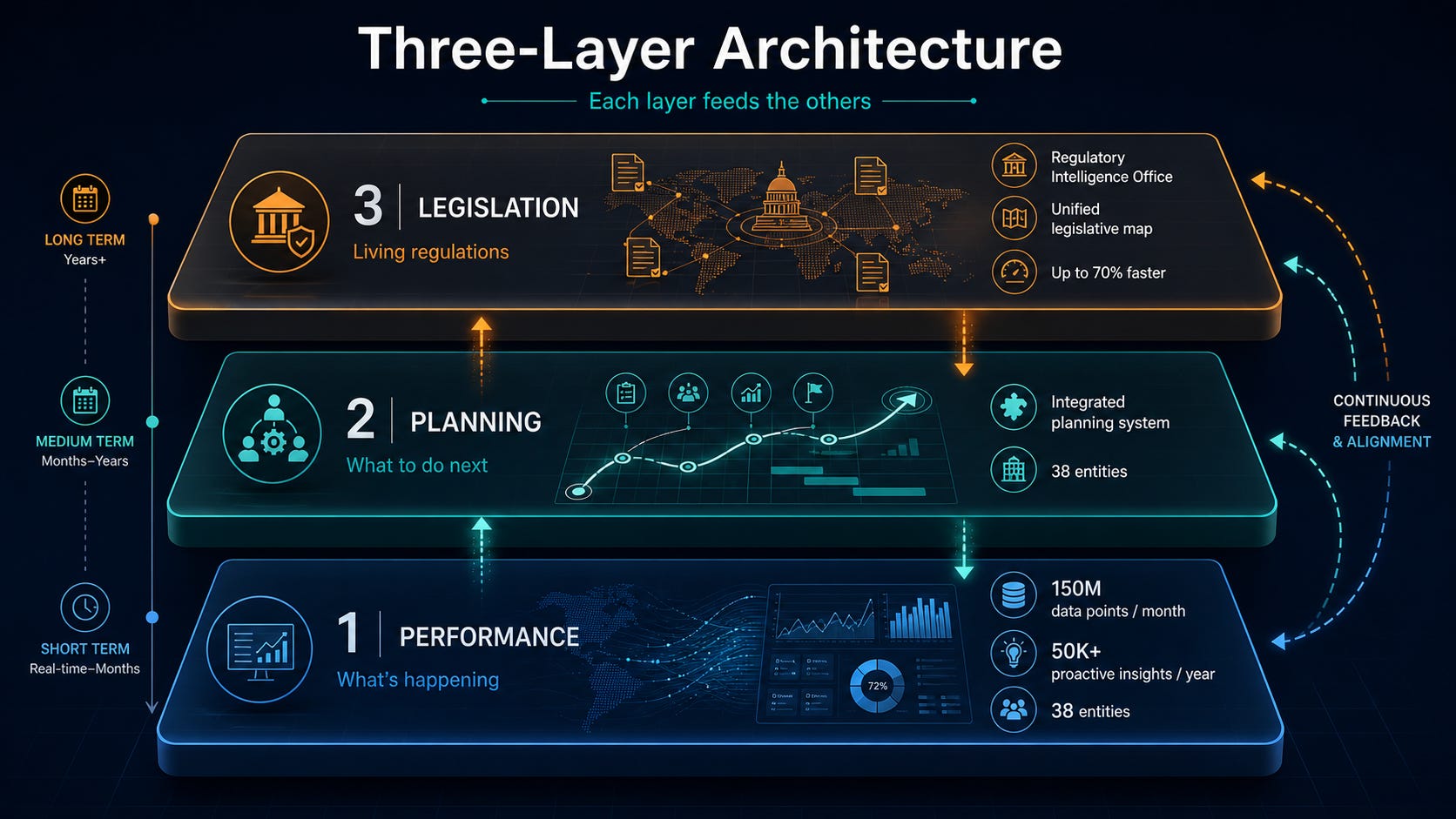
The agentic AI framework announced on 23 April 2026 looks set to become the operational layer connecting all three.
Performance feeds Planning. Planning feeds Legislation. Legislation reshapes the rules under which Performance is measured. Closed loop. Self-modifying. Operating across all three on a single customer’s timeline, controlled by a single Cabinet, executing through a single agentic framework.
If you’re trying to sell into this Agentic State customer, you’re not selling into one of those layers. You’re selling into a system where all three are coupled and evolving together. Your contract is governed by a regulatory frame that the same customer is rewriting on a different timeline.
The seller’s problem, named
In Part One, I introduced Commercial Sovereignty as a business’s right to control the terms under which machine customers can engage with it. At the sovereign scale, two sovereignties usually compress simultaneously on the seller.
The customer’s sovereignty...what it will buy, on what terms, at what price.
The jurisdiction’s sovereignty...the legal frame inside which the deal is governed.
When the customer is the jurisdiction, those two collapse into one actor that controls both sides of the transaction. The seller has no third-party referee.
Within the Five Faces of Machine Customers framework, the sovereign agentic buyer doesn’t sit cleanly inside any one face. It sits between Intermediary Broker and Multi-Agent Customer. Not a single agent...a network of them, operating under a unified policy frame that the same network can edit.
It’s also both Declared and Undeclared at once. The procurement system itself is the most declared machine customer possible...a published policy, a known buyer, a public framework. But the legislative layer is undeclared, co-evolving silently in the background. Single customer. Two opposite states at once. Yeah…that’s new.
This is material rather than theoretical. Walmart’s autonomous negotiation deployment extracts a 3% margin gain across negotiations and extends payment terms by 35 days, with a 68% supplier acceptance rate. BCG’s analysis of payment-term extensions puts the buyer’s working-capital benefit at up to 8% per 30-day extension.
Read that from the seller’s side. 3% margin compression. 35 days of working capital pulled out of your balance sheet. Executed in seconds. Across thousands of touchpoints. A 68% acceptance rate that suggests most suppliers don’t even register what just happened. Procurement teams will report success. The CFO will read the balance sheet and wonder what the AF just happened.
Walmart is a single corporate buyer applying this to one slice of its supply base. Now scale the same mechanic up, fold it inside a sovereign procurement layer, and put a self-modifying legal frame on top. The seller’s exposure stops being incremental.
The asymmetry compounds
Part One closed on the Project Deal finding. Frontier-model agents systematically extract more value than mid-tier agents, statistically significantly, and invisibly to the humans being represented. That finding is the missing piece in the seller’s-problem story.
Speed isn’t the only mismatch. Negotiation-quality is the other one, and it lives at the same axis. The sovereign agentic buyer isn’t operating mid-tier procurement bots. It’s running the best models its budget can buy, on infrastructure it owns or licenses on terms favourable to it. The sellers facing it are operating whatever fits within their procurement budget, which could be models that are far less capable.
So the squeeze is now three things, not one.
The “Agentic State as a customer” rules layer outpaces the seller’s legal review. The customer’s procurement agents outperform the seller’s negotiating agents on a per-deal basis. Neither asymmetry is visible to the human on the seller’s side. Project Deal demonstrated this directly given participants rated lopsided deals as just as fair as balanced ones. The losing side does not register the loss.
What Part One identified as a Global South export problem now compounds inside any sovereign account on a seller’s balance sheet. Margin drift. Payment-term drift. Contract-language drift. None of it visible quarter by quarter. All of it accumulating until it’s structural.
Speed as the weapon
Speed is the structural advantage of this architecture that makes the asymmetry impossible to close.
The UAE Cabinet’s Regulatory Intelligence Office has accelerated legislation by up to 70%. The agentic operational layer announced in April 2026 will execute procurement decisions on a 24-hour cadence at minimum, more likely continuous. Both layers report to the same Cabinet, on the same timeline, under the same policy frame.
Your finance team is on a quarterly cadence. Your legal team is on a two-week cadence. The sovereign buyer is rewriting the rules under which you sell to it on a continuous one.
The mismatch is structural.
Different bets, different bills of materials
The world’s other major jurisdictions are making different bets. Each bet creates a different cost structure for the seller. Two stand out for what they reveal about the agentic-buyer question specifically.
Singapore’s IMDA Model AI Governance Framework for Agentic AI, launched at Davos in January, is the human-accountability bet...covered in my February article. The US is currently fighting itself over what a sovereign customer can demand from an AI vendor: the GSA’s draft AI procurement clause is pending finalisation, and the Anthropic-Department of War dispute is live in the courts. Both worth one sentence each. Neither is the interesting case here.
The story that’s fascinating and truly additive is Estonia and Finland.
Sirte Pihlaja flagged this on LinkedIn and it’s explored in detail by Luukas Ilves and Ott Velsberg. They’re right. The serious work on agentic statecraft is being done in places the global press doesn't always track.
Estonia and Finland deepened their AI cooperation at intergovernmental level. The LUMI AI Factory consortium brings together six countries...Czechia, Denmark, Estonia, Finland, Norway, Poland...building shared sovereign AI infrastructure. 100% renewable. Waste heat piped to Kajaani’s district heating system. Estonia’s Bürokratt blueprint for an agentic state is published on GitHub.
A little deeper and you find another connection. Pactum is Estonian. The autonomous procurement negotiation platform that closed a single deal worth $140.5 million and another one in 87 seconds, now operating across more than 50 Global 2000 enterprises including Walmart, Maersk, Honeywell, Bristol Myers Squibb and Veritiv. Co-founder Kaspar Korjus was the founding Managing Director of Estonia's e-Residency programme. The country that built digital citizenship is also the country that built autonomous procurement negotiation. That isn't a coincidence.
The bet looks like this. The UAE is building a vertically integrated sovereign agentic state for export. Estonia is building a horizontally federated agentic capability across small, sovereign, democratic states. Same category. Opposite power dynamics. One scales by control. One scales by interoperability.
Both are buyer-side architectures. Both are operational. Neither is the US.
Worth noting that the GCC pattern is replicating. Saudi Arabia declared 2026 the Year of AI, unveiled HUMAIN OS in February as an agentic operating system for government and enterprise workflows, and broke ground on the world’s largest government data centre by megawatt in Riyadh. Trailing the UAE but moving on the same trajectory, this is becoming a regional model, not a single-actor experiment.
The liability vacuum
There’s one more piece of this that hasn’t been priced in yet. The sovereign-as-agentic-buyer creates a liability gap that no jurisdiction has closed, and the law that exists actively favours the sovereign.
Yearsley immunity, established in 1940 and reaffirmed across Campbell-Ewald (2016), Cunningham v. GDIT (4th Cir. 2018), and Taylor Energy (5th Cir. 2021), means that government contractors performing within contract scope inherit the government’s immunity. The seller absorbs the loss. The Foreign Sovereign Immunities Act limits when foreign sovereigns can be sued at all. And as the University of Chicago Law Review has documented, AI agents lack legal mens rea. No intent, no liability theory.
No jurisdiction has rules specifically for autonomous AI purchase liability. Not the EU AI Act. Not the GSA clause. Not the IMDA framework. Nobody.
I noted in Part One that American Express’s consumer promise to cover losses from registered-agent erroneous purchases was the closest thing to an answer in the market. Worth saying clearly here, that promise covers consumers. It doesn’t cover enterprise sellers facing sovereign agentic buyers.
When an agentic sovereign buyer makes an erroneous purchase, breaches your supplier terms or extracts margin under rules that changed mid-contract, the legal frame doesn’t favour you. The seller carries the risk. The sovereign keeps the immunity. The AI carries no intent.
The two questions for Part Two
In Part One, I left two questions on the board for the next executive meeting. Which jurisdiction’s rules govern your machine customers? And how would your finance team know if your AI agents were systematically losing?
Part Two adds two more.
If your customer can rewrite the rules of the deal faster than your legal team can read them, what are you actually selling them?
Where in your business model do you assume the regulatory frame is stable, and what breaks the moment it stops being stable?
The first one is structural. The second is a stress test. Most operating models...pricing, margin, contracts, supplier terms, incident response, even product design...assume a static frame. Strip that assumption out, and most don’t survive the next five years intact.
A large part of corporate planning rests on one quiet assumption. That the rules sit still while the deal closes.
If your finance function can’t model what happens when the regulatory frame moves quarterly, and your procurement function can’t tell when it’s losing to a better agent on the other side of the table, you don’t have a finance function or a procurement function fit for this decade.
You have an exposure waiting to be priced.
Katja Forbes is the author of Machine Customers: The Evolution Has Begun and helps organisations prepare for a world where their next customer won’t be human. She advises businesses and speaks globally on Machine Customer Experience and why customer-focused leaders are uniquely positioned to shape this transformation.