We Do the Body. The Customer Does the Brain.
Or what happens when a Hangzhou's VP pitch actually sounds like a confession?

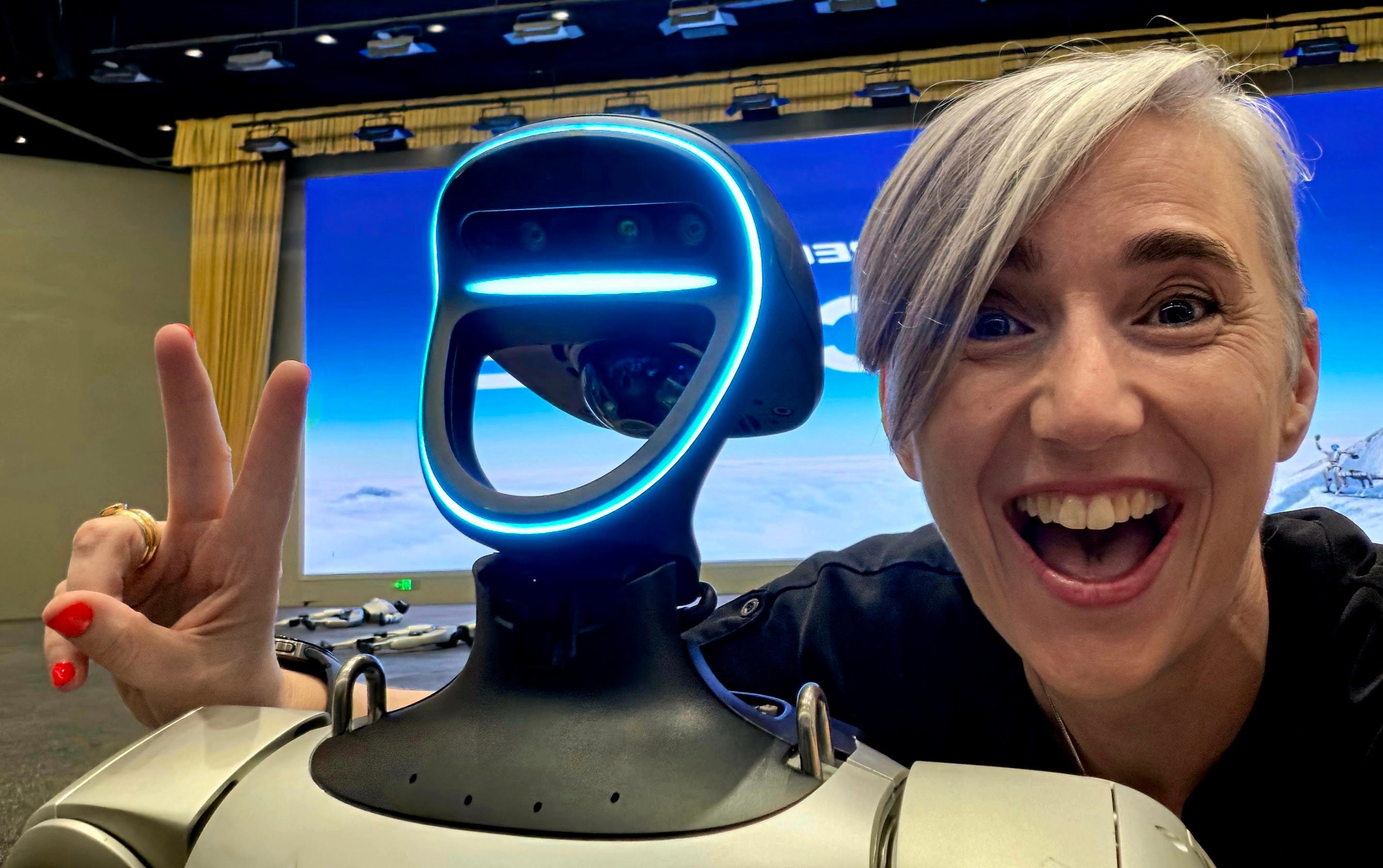
I visited the Unitree Robotics showroom in Hangzhou on 12 May, 2026. There is no substitute for seeing something with your own eyes. One of the quadruped robots “looked” at me for a good ten seconds. I didn’t know whether to feel threatened but for some visceral reason, I did. To be fair, I got to stand on it afterwards, so I guess that balanced the scales.
The staff were kicking and pushing the robots to demonstrate stability…(seriously, why must we do it like this? Everyone hates it! Well non-sociopaths anyway). The quadruped “dogs” steered by handsets, the humanoids running a mix of learned autonomous behaviours and teleoperation. Nobody had put a brain in either of them yet.
In the executive presentation and conversation after we toured the showroom I asked the marketing VP a simple question. When a deployed robot needs a spare part, can it order one itself?
She looked like I’d asked whether the robot dreams then moved on to fill the silence:
“We do the body and the balance. Our customer does the brain.”
That line sums up the gist of this whole article.
Look, that admission isn’t new. The robotics industry has had this conversation before. Pretty much nobody was watching the first time.
Five years ago, Boston Dynamics started selling ‘Spot’ to enterprise customers. Today there are over 1,500 Spots in the field, all running on the company’s proprietary stack… their body, their fleet management software (Orbit), their cloud-based inspection AI. Closed system. End-to-end ownership of the customer relationship. Spot’s been quietly working in mines, oil rigs, and construction sites for years.
ANYbotics did the same thing in Switzerland, more vertically, with industrial inspection as the locked use case. Unitree's Go2 went the other way. Open SDK, ROS-compatible, starting around $2,590 retail, an explicit invitation to install whatever brain you want. Then Carnegie Mellon's Robomechanics Lab released Quad-SDK… a full-stack open-source control framework that runs on Unitree A1 and Ghost Spirit quadrupeds out of the box. Anyone could put their own brain on someone else's body.
Four models.
Proprietary stack at scale.
Proprietary stack, captive.
Open body, brain not included.
Open body, brain built elsewhere.
Now the same four models are loading into humanoid form, with a $39B valuation on one of them and the Spring Festival Gala broadcasting another. The stakes just got cameras pointed at them.
That line from the marketing VP in Hangzhou is their business model. They’re a hardware company, not a software company
Unitree filed for a $610M IPO in March 2026. Buried in the regulatory filing: the company “does not fully understand the specific usage scenarios of customers.” The world’s most profitable humanoid robot maker… 60% gross margin, profitable since 2020, 5,500 humanoids shipped in 2025… ships bodies and waits to see what brains arrive.
Shipping…Open SDK. Python-compatible. Jetson Orin slot, pre-wired and pre-configured to accept Nvidia's AI compute module, included.
They are Foxconn, the body underneath someone else's brand. They just said so in writing.
The brain/body question playing out in humanoids has the same four answers it had in quadrupeds. Different stakes, same shape.
The G1 starts at around $16,000. Anyone with Python can build the “soul”. Unitree doesn’t know what customers are doing with their robots, and that’s the feature. Volume and margin without the liability of the intelligence layer. Same playbook as the Go2, scaled up to humanoid form and IPO-ready.
(No, this is not the most impressive robot dancing video that I took that day, but I could not pass up the irony of a robot doing “The Robot”. It was just too ridiculous for words.)
Then there’s Figure. Body, brain, and operational relationship all in-house. Figure built Helix, a Vision-Language-Action model that lets robots generalise to objects they’ve never seen, respond to natural language, coordinate with each other. Figure 02 worked 10-hour shifts at BMW Spartanburg for 11 months, contributing to the production of more than 30,000 X3 vehicles. Figure 03 targets $20,000. Owning the full stack earns the right to own the customer relationship. That’s the bet.
Then there’s Atlas. Body and brain integrated, single customer. All 2026 Atlas units committed to Hyundai and Google DeepMind before shipping, around $145,000 per unit. When the Korean Metal Workers’ Union blocked Atlas from Hyundai’s factory floors in January 2026, the entire deployment stopped. One body, one brain, one customer, one point of failure. Same model Boston Dynamics already runs with Spot. Hyundai cast as the captive customer this time.
And then there’s Maya.
A team in Delhi bought a Unitree G1. They named her Maya. They went to Sarojini Market for her outfit. They put Gemma 4 in her head, running locally so nobody in Hangzhou can switch it off. ElevenLabs gave her a voice with a Delhi accent. They programmed her hands to move as she talks, because “when we humans speak, we make slight movements with our hands as we speak, which she was missing.”
Maya is walking the streets of Delhi interacting with people.
Video Credit: Sohan Rai (Zikiguy)
Unitree probably has no idea Maya exists.
So, while Unitree ships bodies, the brains are being built in universities and in data factories.
In Beijing’s Shijingshan district, a 10,000 square metre facility opened in late 2025. Inside: 100 humanoid robots, 16 scenarios replicating factories, smart homes, and elder care facilities. Human operators guide them through tasks using VR headsets and motion capture equipment. Every movement recorded as training data. 12,000 data collection tasks per day. In Indian textile factories, the cameras are smaller, the workers were not asked, and the consent question is darker. But that’s a tale for another article.
What that actually looks like, I saw in Hangzhou. A man in a VR headset, controllers in each hand, teaching a G1 to sweep up a cup with a broom and dustpan and drop it in a bin. One demonstration. Then another. Then another...Painful.
Wang Xingxing, Unitree’s own founder, said at the 2026 Humanoid and Embodied Intelligence Standardisation Annual Meeting that imitation learning, using real human demonstration data, allows robots to gradually acquire human-like actions.
China tech analyst Jeffrey Towson visited the same Unitree showroom in March 2025. He wrote afterwards that the robots had “a range of actions that are trained in simulation and then downloaded… not embodied intelligence yet. At least not publicly.” Fourteen months later, the choreography is sharper. The architecture is about the same. That said, one week after my visit, a Unitree humanoid fell twice trying to moonwalk in Shenzhen and had to be dragged off stage. The choreography, it turns out, was not that sharp after all.
The brain is humans in VR headsets. For now.
Which brings us to the actual question we need to be asking. When Maya walks the streets of Delhi and starts transacting… buying things, making choices, interacting commercially… who holds Commercial Sovereignty over that relationship? Under what terms is Maya transacting with these companies and who sets them?
Not Unitree. They made the body. They said so.
Not Google. They made Gemma 4, but it runs locally on Maya… air-gapped from Mountain View.
Not ElevenLabs. They just made the voice.
The Tuesday Labs built the intelligence, the persona, the character, the commercial interaction model. They own Maya’s soul. A small creative team in Delhi, not a commercial entity with a governance framework.
Now let’s scale that question.
There are 1,500+ Boston Dynamics Spots in the field today. When one of them flags a worn actuator and orders a replacement, the request goes to whom? The mine operator who owns the robot? Boston Dynamics, who built the stack? The parts supplier who fulfils the order? When 25,000 Atlas units are deployed across Hyundai’s factories, each one transacting on its own behalf for energy, parts, software updates, calibration services… whose terms govern those transactions? Hyundai’s procurement policies? Boston Dynamics’ SLA? Some third standard nobody has written yet?
If your business sells anything that a machine might buy…be it parts, energy, logistics, software, services…your terms of trade were written for a counterparty with a legal personality. Machines don’t have one. Yet.
And there is no regulation. No international framework governs humanoid robots. No US federal law. No EU-specific standard for walking machines. ISO 25785-1, the first safety standard for dynamically stable walking robots, is still being drafted. If Maya has an incident on the street, the liability chain runs hardware maker, brain installer, operator, user. Nobody has tested who sits where.
The body/brain split is a legal vacuum dressed as an engineering decision.
The humanoid robot market will consolidate. China's National Development and Reform Commission (NDRC) has said so. Companies without revenue will be acquired or dissolved.
The companies that survive will have staked a position on the same question their quadruped predecessors didn’t have to answer five years ago. Who governs the machine when it buys. Who accepts the machine's authority when it sells.
Boston Dynamics chose the stack and built it for quadrupeds and humanoids. Unitree chose the body and did the same. Maya’s makers, for now, chose the soul.
Imagine the boardroom conversation. When someone else's machine places an order with you, whose intelligence are you actually transacting with? Whose authority are you accepting? Did you ever agree to those terms? Somewhere in your supply chain, a machine is about to place an order. Maybe it already has. Are your terms of trade even written for that conversation?
Perhaps the most important procurement decision of the decade is being made by someone who thinks they’re buying hardware.
Again.
Katja Forbes is the author of Machine Customers: The Evolution Has Begun and helps organisations prepare for a world where their next customer won’t be human. She advises businesses and speaks globally on Machine Customer Experience and why customer-focused leaders are uniquely positioned to shape this transformation.