Your AI Customer Doesn't Learn
or "50 First Transactions"

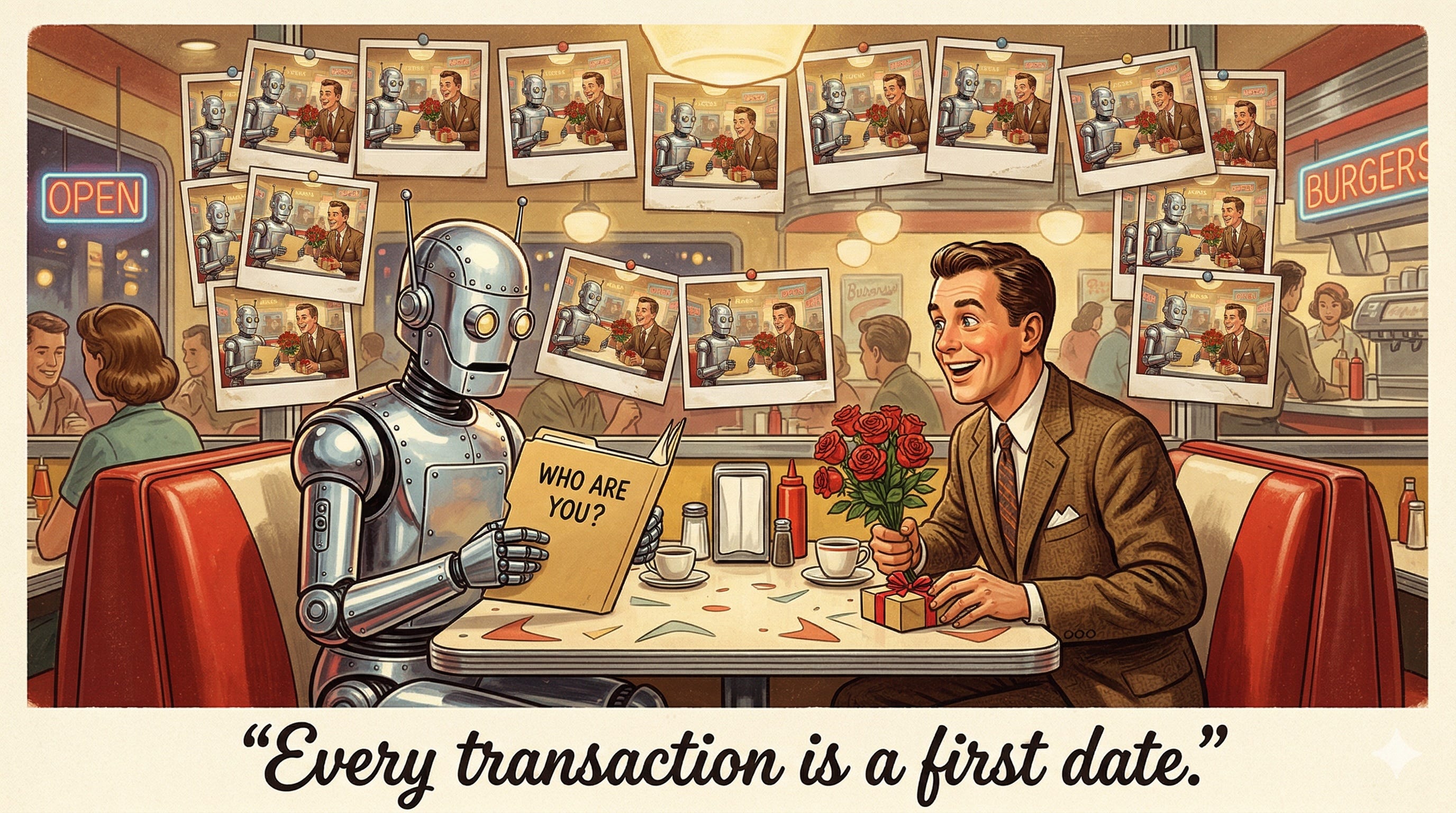
Node 741 detects a conveyor belt vibration anomaly at 1am. It queries three suppliers. One matches on price and speed. Node 741 places the order, arranges delivery, updates the factory’s systems. By 9am the part is en route.
The supplier delivers two days late.
A human procurement officer would remember that. Next quarter, when the same part is needed, they’d weight reliability differently. They’d negotiate harder on delivery guarantees. They might call the supplier’s competitor first.
Node 741 won’t do any of that. Tomorrow it runs the same evaluation logic it ran yesterday. It didn’t learn from the experience. It can’t.
Companies are pitching you 'autonomous AI agents' and conveniently leaving this out.
The people who built AI are telling you it's broken
Last week, three hugely prominent AI researchers, Emmanuel Dupoux, Yann LeCun, and Jitendra Malik, published a paper with a blunt title: “Why AI Systems Don’t Learn And What To Do About It.” Their core argument is that current AI models, once deployed, learn essentially nothing. Learning is outsourced to human engineers who curate data, build training recipes, and fine-tune models offline. The systems themselves are frozen at the point of deployment.
"In current AI systems, learning is outsourced to human experts instead of being an intrinsic capability."
LeCun didn’t stop at writing. He left Meta after twelve years and raised $1.03 billion to build something different…AI systems based on world models rather than large language models. David Silver, the architect behind AlphaGo, raised another billion for the same reason. Fei-Fei Li’s World Labs raised a billion more. That’s $3 billion in seed funding in in barely a month, all from people who believe the current approach can’t get us to AI systems that genuinely learn from experience.
Now, the CEOs of OpenAI, Anthropic, and Google DeepMind disagree. They think the current architecture can be extended. OpenAI’s $110 billion raise, one of the largest private investment in history, is buying bigger language models, not world models. This is not a settled debate.
Both camps do agree on on thing though. The AI agents being deployed as your machine customers right now do not learn from their purchasing interactions. The argument is about whether that’s a permanent limitation or a temporary one. While we can concede the AI landscape moves blisteringly fast, the timeline for fixing this is measured in years, not months.
What "frozen" means for commerce
So what does “frozen” actually mean when your customer is an algorithm?
It means no accumulated preferences. No memory of which supplier delivered on time and which didn’t. No loyalty built through repeated positive experiences. Every single transaction is evaluated from scratch against pre-set parameters. Your machine customer doesn’t care that you’ve served it reliably for eighteen months. It has no idea.
Think about how different this is from human expertise. An experienced procurement officer doesn’t check a manual before negotiating a supplier contract. The knowledge has been transformed through years of practice into capability. AI agents never make that leap. Every task requires loading instructions from scratch which is the irritating equivalent of reading the manual every single time, no matter how many times they’ve done the job before.
What looks like competence is actually retrieval masquerading as understanding.
It also means these systems are brittle in ways that matter commercially. The AI researchers call it “domain mismatch” when agents trained on general data get deployed into specific procurement contexts with pricing dynamics, supply chain disruptions, and vendor quality signals they’ve never encountered. The paper argues this can’t be fixed by simply training on more data, because real-world commerce is what they call “heavy-tailed”, which means there are always new situations, and conditions keep changing.
The enterprise data backs this up. MIT found that 95% of corporate AI initiatives haven’t delivered measurable P&L impact. McKinsey reports only 23% of enterprises are actually scaling AI agents and the rest are stuck in experimentation. And the compound error problem is brutal. If an agent achieves 85% accuracy on each individual step, a ten-step purchasing workflow succeeds only about 20% of the time.
These aren’t systems that are going to out-negotiate your sales team anytime soon. But they are systems that are already placing orders, and their numbers are growing fast.
Winning a logic test, every time, from scratch
If your machine customers can’t learn to prefer you through experience, what’s left?
Start with the table stakes. Structured data, reliability signals, performance transparency, machine-readable proof that you deliver what you promise. This is the agent readiness foundation and trust infrastructure and without it, a frozen customer can’t even evaluate you. Most companies haven’t built this yet, and they’re already behind.
Discoverability and trust gets you into the room but it doesn’t differentiate you and win the deal.
"If AI is to be truly useful, it must understand worlds, not just words." - Fei-Fei Li, World Labs
What wins is values. What makes you uniquely different from your competitors. Your sustainability credentials, encoded as machine-evaluable constraints. Your ethical sourcing commitments, structured so an agent can parse them. Your data sovereignty posture, your compliance certifications, your community investment track record…all translated from marketing language into decision criteria that an algorithm can weight.
“You’ve got to stand for something or you’ll fall for anything.” - Aaron Tipper
I’ve written about this as the Three Altitudes of Agentic Commerce.
Foundation is technical readiness. Things that look like schema, APIs, payment protocols. Trust is verification where we see analyst recognition, customer evidence, performance signals. Stratospheric is values. This is what your brand stands for, made legible to machines. Most companies are scrambling to get Foundation right. The ones that will own their categories are already encoding values.
This matters more when customers are frozen because a human buyer who can’t verify your sustainability claims might give you the benefit of the doubt based on a relationship. A frozen machine customer has no relationship to fall back on. It evaluates what’s in the data. If your values aren’t encoded, they don’t exist.
Think about what this means for competitive strategy. With human customers, you build relationships over time. You recover from a bad quarter with better service the next one. You earn loyalty through accumulated experience. With frozen machine customers, you’re winning (or losing) a logic test. Every time. From scratch. The companies that encode their values into that test don’t just compete. They set the criteria.
The companies that understand this have a head start that compounds. Not because they’re serving today’s frozen agents better (though they are), but because they’re building the data infrastructure that future learning agents will consume. When machine customers eventually can learn from experience, whether that takes the new architectures LeCun is building or the extended language models the other camp is betting on, the businesses with the richest, values-led, most structured feedback loops will be the ones those agents learn to trust first. Everyone else starts from zero.
The researchers will sort out whether this limitation is permanent or temporary. That debate could run for a decade. The business implication doesn’t wait.
Right now, and for the foreseeable future, your fastest-growing customer segment is incapable of remembering you.
Build accordingly.
Want to know if your values are visible to machine customers? I built a tool for that. Take the Values Signal Audit.
Katja Forbes is the author of “Machine Customers: The Evolution Has Begun” and helps organisations prepare for a world where their next customer won’t have a face or feelings. She advises businesses and speaks globally on Machine Customer Experience and why customer focused leaders are uniquely positioned to shape this transformation.