Go Ahead. Tax the Robots.
Or: What happens now the non-human layer has landed in the economy.

A closed-door breakfast. A room of bank and enterprise CTOs, talking candidly about where this all goes.
One of them described the moment he’s planning for. The day AI agents get charged out like consultants. A day rate. The full cost of owning and running the thing, passed straight to whoever it works for.
Another came at it from the opposite side. He’d assumed his data vendor would simply ship him agents that did the analysis, sitting on top of the data platform he already paid for. Logically, he’d assumed he’d pay for them, the way you…you know… pay for work.
Same table, same future, built from both ends. The agent has a day rate. And somebody’s already budgeting to pay it.
A charge-out rate is revenue. Compute and tokens are cost. The gap between them is margin. Anything with a margin starts to behave like a business.
This all raises a very interesting question. A consultant who gets charged out pays tax on the labour she sells. So when the agent that may have taken over a human role is charged out…who pays the tax on that? Its owner? Tagged like a product or service offering and in one homogenous bundle of agent income tax fees?
Sounds like a thought experiment but it’s not. Bloomberg has already put a coordinated network of agents on the Terminal under ASKB, exposed to clients as analytical work they pay for. The agent has stopped being a feature on the platform. It’s a line item with a margin attached.
And notice which agent this is. The one being charged out as labour can be the same one doing the buying… the autonomous purchaser, the machine customer, already running procurement on someone’s behalf. One entity, both sides of the ledger. It earns. It spends. Confusing hey?
But under scrutiny, it falls over. The agent can’t pay the tax, because the agent isn’t a taxpayer. It has no tax file number, no filing obligation, no legal standing of any kind. As the practitioners who actually have to file this stuff point out, the tax consequences of whatever an agent does flow back to the principal it acts for. The human, or the company, standing behind it.
Watch what happens once you accept that. Every serious proposal to tax AI, followed to its end, lands on the company. OpenAI’s own industrial-policy paper wants to shift the base toward capital and automated-labour levies. Anthropic’s Dario Amodei floated a cut of revenue every time a model runs. Bernie Sanders wants a levy per replaced worker. Mark Cuban would “tax Tokens at the Provider level,” then conceded the cost gets passed to the customer anyway. Bill Gates proposed taxing firms on their robots’ imputed income back in 2017. There’s even a paper literally titled Taxing the AI Agents… and it, too, routes the tax to the corporation.
The Financial Times recently mapped the field, with Monzo’s Tom Blomfield summing up the consensus: tax the compute, not the labour. The whole argument is about which input to tax. Compute. Tokens. Revenue. Imputed workers.
Not one of them taxes the agent because not one of them can.
Charged out like a person. Taxed like a tool.
The reason ‘why’ is the part the tax debate keeps walking past. You cannot levy a tax on something you cannot identify and attribute to a human. Taxation is downstream of identity. It’s the same wall I wrote about when agents started shopping on our behalf… there it showed up as a fraud problem. You can revisit that article here:

Now it’s a fiscal one. One missing identity layer, wearing different costumes. You can’t tax what your machine customer sells, and you can’t attribute what it buys, for the identical reason. Nobody can prove which human stands behind it.
Which is what makes the alternative so revealing. Say you didn’t want to bundle the agent as a tool. Say you wanted to tax it as a worker, individually, for the labour it took over from a person. You would first have to track it individually. Give it a discrete identity. Ascribe a value to its labour, and book a tax contribution against that value. Do all that, and you’ve built an entity… named, valued, accountable. Taxing it like a worker means first making it one.
The kicker comes from the lawyers. Reuven Avi-Yonah predicts firms will wrap their autonomous agents inside corporate shells to cap liability. The moment they do, the agent acquires exactly the legal identity that makes it taxable… and the same identity that makes it a far more capable autonomous buyer. Know Your Agent, then Know Your Human. The scaffolding that lets you tax an agent is the scaffolding that lets it transact. One structure, both jobs.
You can already see which way the regulated market leans. When Robinhood opened to agents in May, a regulated US broker had every chance to let the machine act with real standing. It did the opposite. The agent gets an isolated sub-account holding only the funds the customer deposits, a spending limit the customer sets, and a kill switch. The disclosure pins authorisation and all risk to the human, and states flatly that Robinhood does not supervise the agent at all.
The frontier fantasy was machine personhood. The regulated answer is human-anchored delegation, drawn in legal ink. The principal is on the hook. The agent is a tool with a leash.
All of which assumes a very Western problem. The entire panic rests on one premise that AI erodes a tax base built on labour income. Pull that premise out, and the question fractures further.
In the Gulf, it evaporates. There is no personal income tax for an agent to erode. The fiscal model already runs on sovereign wealth and consumption, which is why OpenAI’s proposed “public wealth fund” reads, from Abu Dhabi, like a description of a regular day in the UAE.
Korea has the one piece of real-world data anyone’s collected. After it trimmed automation tax credits, affected industries installed roughly 28% fewer robots than their Japanese peers. Tax the machines, get fewer machines.
China runs the whole thing in reverse. Shenzhen’s Longgang district isn’t taxing agent deployment, it’s subsidising it as industrial policy. Because the Chinese state can attach a real-name identity to almost anything, it could actually attribute an agent’s actions to a principal…solving by fiat the precise problem the West is still debating.
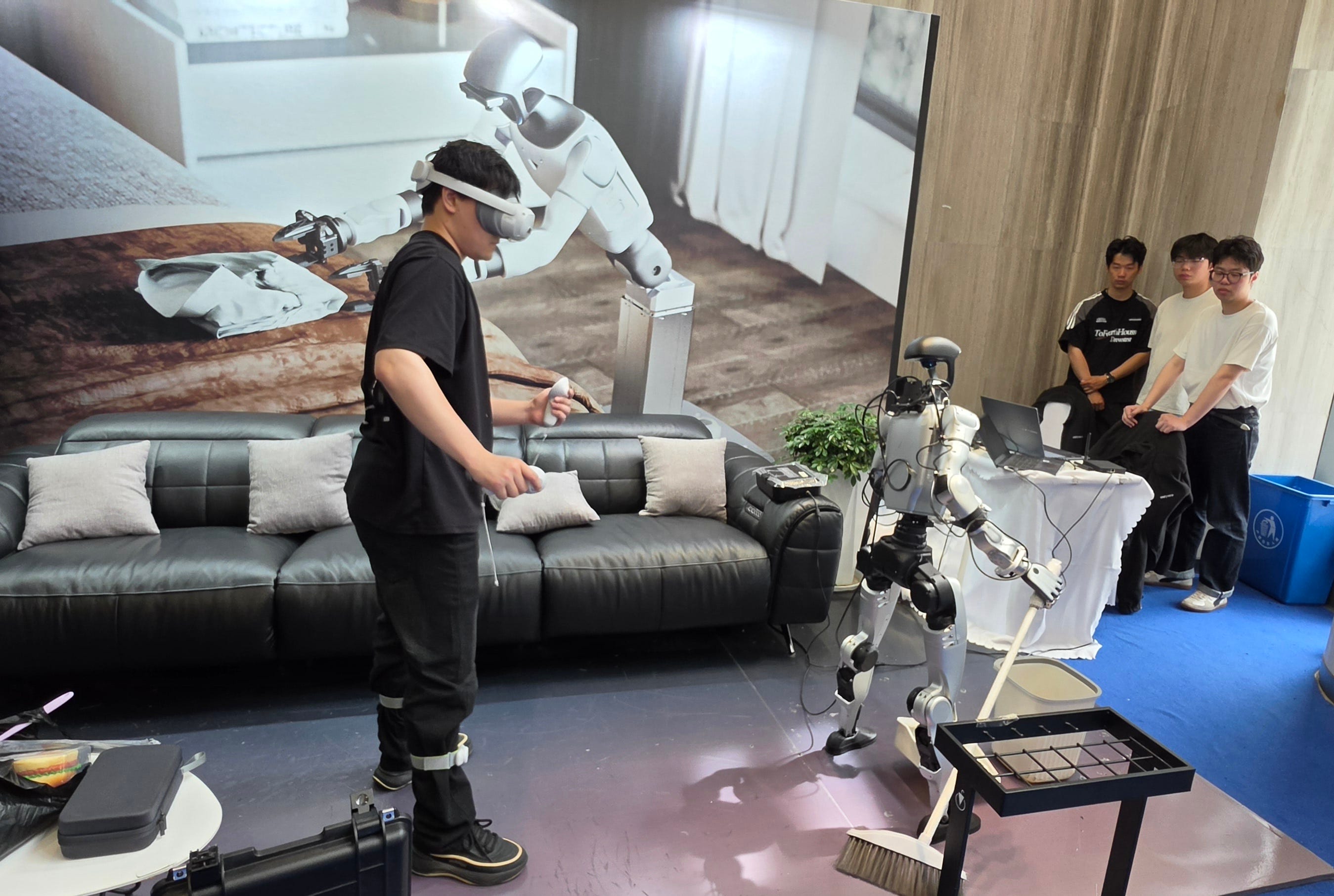
Humans at Unitree Robotics teaching the robots how to sweep up. Clearly still a work in progress.
India is the most exposed economy on earth here. The white-collar back office for half the planet, the exact layer agents replace. Its own Economic Survey warns against rushing to tax automation profits. It’s also the same market where the push to extend Aadhaar-style identity rails to agents is already being argued.
Four fiscal models, four different questions. One constant underneath all of them: you cannot tax, subsidise, or blame an agent you cannot identify. China and India are building that identity layer. The West is still debating whether it’s possible. The Gulf never needed it…for this purpose anyway.
So before the policy people settle which input to tax, your own firm has a simpler problem. The agent charged out to you as labour is the same agent buying from you as a customer… your machine customer, sitting on both sides of the one ledger. You can’t tax what it sells. You can’t attribute what it buys. Underneath both sits a single unanswered question.
Who is the human behind it?
Whoever that is, that’s where the liability lands, where the tax lands, and where the terms of engagement get set… by you, now, or for you, later. That’s the sovereignty question hiding inside the tax one.
You’re about to be on one side of that ledger or the other. Do you know your machine customer well enough to say which?
Katja Forbes is the author of Machine Customers: The Evolution Has Begun and helps organisations prepare for a world where their next customer won’t be human. She advises businesses and speaks globally on Machine Customer Experience and why customer-focused leaders are uniquely positioned to shape this transformation.